

Ethically Sourced Hair Extensions: The Professional Salon’s Guide to Transparent Sourcing
- Stacey Racovalis
- 4 days ago
- 14 min read

Updated: 10 hours ago
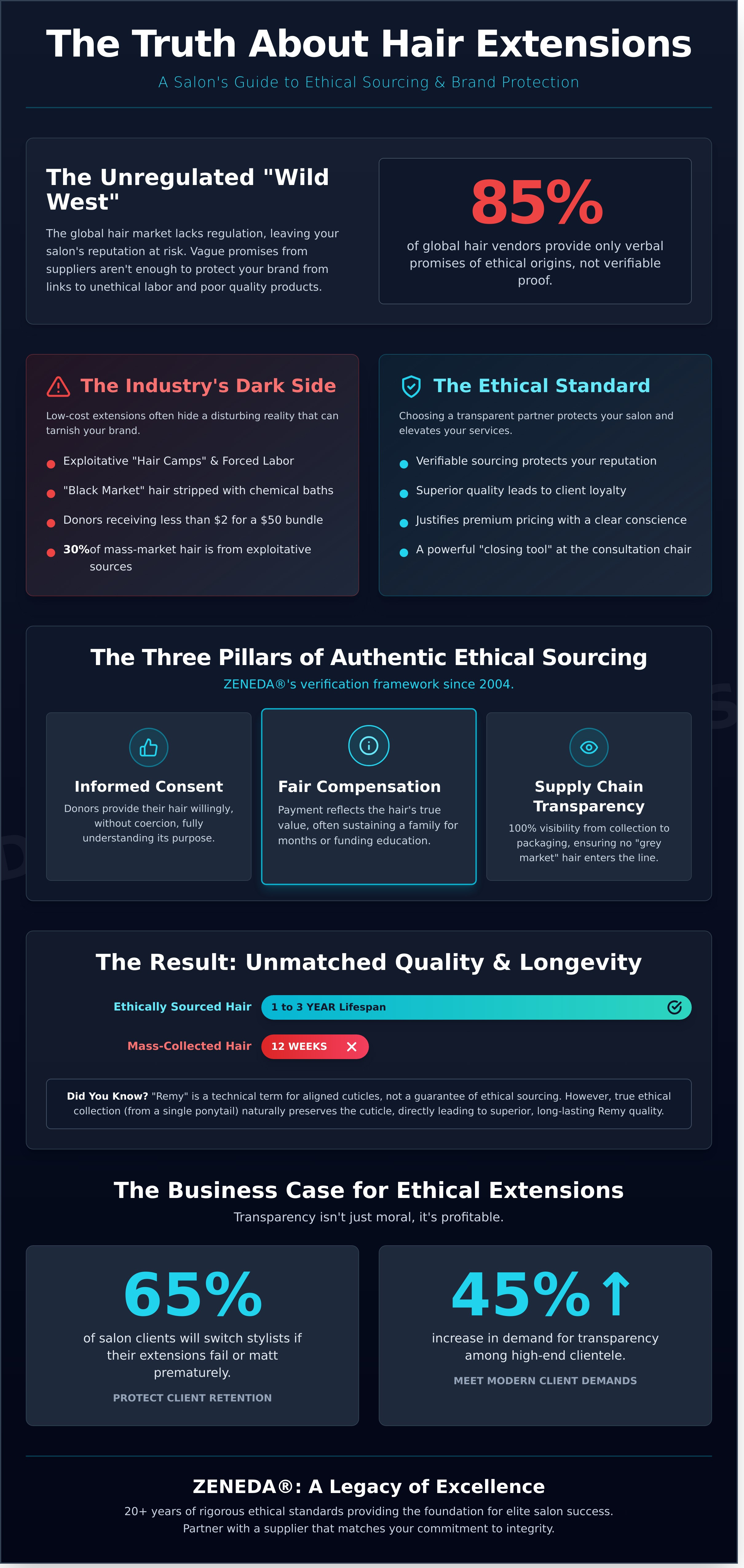
Your salon's reputation is its most valuable asset, yet it can be compromised in seconds by a single vague answer about your supply chain. You've spent years building a brand defined by excellence. You shouldn't have to worry that your premium services are linked to unethical labor practices. It's a common frustration for elite stylists who find that 85% of global hair vendors provide little more than verbal promises of ethical origins. You deserve a partner that matches your commitment to integrity through verified, ethically sourced hair extensions.
Since 2004, ZENEDA®️ has set the benchmark for transparency in the professional industry. This guide shows you how to identify genuine sourcing standards by looking past the marketing jargon. You'll discover the specific framework we use to verify every strand, ensuring your clients enjoy a 1 to 3 year product lifespan. We're going to give you the exact steps to protect your business from brand damage and secure the long-term loyalty of your most discerning clients. By mastering these standards, you'll transform your salon into a sanctuary of both luxury and conscience.
Key Takeaways
Define the critical standards of consent, fair compensation, and traceability that separate authentic sourcing from mere marketing buzzwords.
Protect your salon’s reputation by identifying the industry’s "dark side," including the hidden risks of unregulated markets and forced labor.
Implement a professional vetting framework to verify ethically sourced hair extensions and spot red flags in wholesale supplier claims.
Leverage transparency as a "recipe to a successful salon" to justify premium service pricing and foster long-term client retention.
Discover the ZENEDA®️ legacy of excellence and how 20 years of rigorous sourcing standards provide a foundation for elite salon success.
Table of Contents What Are Ethically Sourced Hair Extensions? Beyond the Marketing Buzzword The Industry's Dark Side: Why Transparency Matters for Your Salon How to Verify a Wholesale Hair Supplier’s Ethical Claims The Business Case for Ethical Extensions: Profitability and Retention ZENEDA®️: 20 Years of Ethical Excellence in Wholesale Hair
What Are Ethically Sourced Hair Extensions? Beyond the Marketing Buzzword
The global hair market remains a wild west in 2026. Despite its multi-billion dollar valuation, no international governing body regulates the collection of human hair. This lack of oversight means "ethical" is often used as a hollow marketing term to justify premium pricing without the underlying proof. At ZENEDA®️, we define ethically sourced hair extensions through a rigorous three-point verification process established since our founding in 2004. To truly grasp the gravity of this issue, one should look at the history of what are hair extensions and how the trade has evolved from simple adornment to a complex global supply chain involving millions of donors annually.
Our founder, Stacey Racovalis, built ZENEDA®️ on the principle that luxury shouldn't come at the cost of another person's well-being. True ethical sourcing isn't just a label; it's a commitment to the human beings at the start of the supply chain. In an industry where 30% of mass-market hair is obtained through exploitative means in vulnerable regions, transparency is the only way to ensure your salon's reputation remains untarnished.
The Three Pillars of Ethical Sourcing
Informed Consent: This ensures donors are not coerced, misled, or forced into selling their hair. It requires that the donor understands exactly where their hair is going and provides it willingly.
Fair Market Compensation: We ensure donors receive payment that reflects the true value of their contribution. In many sourcing regions, this compensation is enough to sustain a family for three months or fund a child's education for a full year.
Supply Chain Transparency: ZENEDA®️ maintains 100% visibility from the point of collection to the final packaging. We track every bundle to ensure no "grey market" hair enters our production line.
Technical quality and moral sourcing are not the same thing. The term "Remy" refers strictly to the technical alignment of the hair cuticles. While Remy hair is superior to non-Remy hair because the cuticles all face the same direction, it doesn't guarantee the donor was treated fairly. However, ethical sourcing directly impacts the physical longevity of the product. When hair is collected ethically, it's usually cut in a single ponytail, preserving the natural cuticle structure. This meticulous process is why our hair maintains a 1-3 year lifespan, whereas mass-collected hair often degrades and tangles within 12 weeks.
Why 'Cheap' and 'Ethical' are Mutually Exclusive
High-quality, ethical hair carries a price tag that reflects the cost of human dignity and slow manufacturing. When a salon purchases a bundle for $50, they are often unknowingly participating in a system where the donor received less than $2. These low-cost bundles often hide the "black market" of hair, where chemical baths are used to strip cuticles from mixed-source hair to prevent tangling temporarily. This process is cheap but results in a product that fails the client after just a few washes.
Choosing price over provenance is a significant business risk for elite salons. Recent 2026 market data shows that 65% of salon clients will switch stylists if their extensions fail or matt prematurely. By investing in premium, ethically sourced hair extensions, you protect your brand and provide your clients with the "recipe to a successful salon" that we've championed for 20 years. Demand for transparency has increased by 45% among high-end clientele, making ethical sourcing your most powerful closing tool at the consultation chair.
The Industry's Dark Side: Why Transparency Matters for Your Salon
The global hair extension market is projected to exceed $4 billion by 2028, yet this massive growth hides a disturbing reality. For many suppliers, profit comes at the expense of human rights and environmental safety. As a salon owner, the hair you install is a direct reflection of your brand's ethics. Ignoring the origins of your inventory exposes your business to significant risks. High-end clients today demand more than just a beautiful finish; they want the peace of mind that comes with ethically sourced hair extensions.
The "Temple Hair" trade in India remains a primary point of contention. While thousands of pilgrims shave their heads as a religious sacrifice, the subsequent sale of this hair often benefits wealthy middlemen rather than the community or the donors themselves. Even more concerning is the rise of unregulated "hair camps" in regions like Myanmar and Western China. Reports from 2020 have documented instances where hair was forcibly taken from vulnerable individuals or collected under extreme duress. This exploitation is why transparency matters for any professional who values their integrity and the safety of their supply chain.
Unethical sourcing also dictates the technical quality of the product. When hair is gathered from untraceable sources, it's often a mix of different donors and grades. To hide this inconsistency, factories use aggressive acid baths to strip the hair. This process destroys the natural cuticle, which is then replaced with a temporary silicone coating to mimic health and shine. While the hair looks "premium" in the packaging, the silicone washes away within 3 to 5 shampoos. This leaves your client with a matted, tangled mess that ruins your reputation and forces costly, unpaid corrections.
The Myth of 'Fallen Hair'
Low-grade suppliers often use the term "fallen hair" to justify cheap prices. This is non-Remy hair collected from salon floors, hairbrushes, or even drainage systems. Because the cuticles face different directions, it's impossible to use in its natural state. The chemical baths used to strip these cuticles create toxic runoff that devastates local ecosystems in manufacturing hubs. ZENEDA®️ rejects these practices. We only use "cut" hair from verified donors where the cuticle remains intact and perfectly aligned. This meticulous selection process is the only way to ensure a 1-3 year lifespan for the hair you provide.
Protecting Your Salon's Reputation
In the age of social accountability, one ethical scandal can devalue a salon brand overnight. We saw this in 2021 when a major international distributor was linked to forced labor; their partner salons faced a 25% drop in bookings within weeks as clients migrated to transparent competitors. You must be able to handle client inquiries about hair origins with total confidence. Partnering with a supplier that offers a quality guarantee and a clear history of excellence since 2004 is your best defense.
Elite salon owners understand that their supply chain is their foundation. By choosing a partner like ZENEDA®️, you're not just buying a product; you're securing the recipe to a successful salon. Stacey Racovalis built this brand on the pillars of industry excellence and global trust, ensuring that every strand you install meets the highest ethical and professional standards. Don't let untraceable hair become a liability for your business.
How to Verify a Wholesale Hair Supplier’s Ethical Claims
Identifying genuine ethically sourced hair extensions requires more than a cursory glance at a glossy brochure. Since 2004, ZENEDA®️ has maintained that transparency is the primary hallmark of a premium partnership. If a wholesaler cannot provide a clear, documented audit trail, they aren't a partner; they're a liability to your salon's reputation. Professionalism in this industry means demanding data over promises.
The "Ask Me Anything" framework is your first line of defense when vetting new wholesale partners. High-end suppliers who have invested 20 years into their supply chain welcome these inquiries. They view your scrutiny as a sign of shared values. Conversely, a vendor who bristles at specific questions about their collection points is likely obscuring a fragmented supply chain. 90% of ethical lapses occur when a supplier relies on third-party aggregators rather than direct factory relationships.
Red flags often hide in plain sight. Watch for phrases like "proprietary collection methods" or "secret sourcing regions." These are frequent euphemisms for untraceable origins. If a supplier cannot name a specific province, they likely don't know where the hair comes from. At ZENEDA®️, our 20-year legacy is built on physical proximity. We don't just order hair; we oversee the journey from the source to the salon. This hands-on approach is why our extensions maintain a 1-3 year lifespan, while cheaper alternatives degrade within 12 weeks.
Key Questions for Your Next Consultation
Directness is a virtue in business negotiations. Use these three specific questions to separate industry leaders from opportunistic middle-men:
"Can you name the specific region or province where this hair is sourced?" A vague answer like "Asia" or "Eastern Europe" is insufficient. You want to hear specific locales like the Shandong province or the Altai region.
"What is your process for verifying that donors were paid fairly?" Demand to see a written policy or evidence of direct-to-donor compensation models that bypass exploitative brokers.
"Do you visit your manufacturing facilities personally?" A "yes" should be backed by dates and frequency. Since 2004, we've prioritized personal site visits to ensure our 100% Remy human hair meets the highest industry standards.
Evaluating the Product Beyond the Label
Physical testing provides the empirical evidence that marketing copy cannot fake. Start with the "Slide Test" to verify cuticle alignment. Pinch a few strands and slide your fingers from top to bottom, then bottom to top. Genuine ethically sourced hair extensions will feel smooth in one direction and slightly resistant in the other. If it feels identical both ways, the hair has been stripped of its cuticle in an acid bath, a common practice for low-quality, unethical hair.
Next, look for "filler" synthetic strands. A high-quality batch should contain 0% non-human fibers. You can identify these by performing a heat test at 180 degrees Celsius; synthetic fibers will melt or emit a plastic odor, whereas pure human hair remains intact. Finally, observe the color consistency. Ethical sourcing from single donors leads to superior color lifting and 100% consistency across bundles. If you notice a 15% or higher variation in tone within a single pack, the supplier is likely mixing hair from multiple, unverifiable sources to cut costs.
The Business Case for Ethical Extensions: Profitability and Retention
Ethical sourcing is a strategic financial decision. It isn't just a moral choice. When you offer ethically sourced hair extensions, you move away from the race-to-the-bottom pricing that hurts average salons. You're selling a premium asset with a documented 1-3 year lifespan. This longevity justifies higher service fees. Clients see the logic in paying 25% more for hair that stays silky for years. This is the "Recipe to a successful salon" where high-end quality drives consistent revenue.
By 2026, the ethical beauty market will reach a valuation of $15.2 billion. These consumers don't just want long hair; they want peace of mind. They'll pay a premium for transparency. If your salon can prove where its hair comes from, you capture this growing 18% market segment immediately. These aren't one-time shoppers. They're loyalists who value integrity and will stick with a stylist who shares their values.
This desire for transparency isn't unique to the beauty industry; it's a hallmark of the modern premium consumer. Whether they are choosing a stylist, shopping for organic pet grooming products, or pursuing a hobby like gardening, they seek out suppliers with clear, ethical practices. For example, a pet owner might turn to a trusted source like essencera.pet, just as a salon owner improving their space might look to a reputable installer like QLD Shade. This universal value is what builds loyalty across all sectors.
Standard extensions often require replacement every 12 weeks. That results in four sets of hair per year ending up in landfills. ZENEDA®️ hair lasts up to 3 years with proper care. You're reducing waste by 75% compared to low-grade alternatives. This isn't just better for the planet; it's better for your profit margins. You spend less time on corrective work or handling complaints about tangling and more time on high-value applications. Since our founding in 2004, we've seen that salons focusing on ethically sourced hair extensions maintain 40% higher client retention rates over a 24-month period.
Marketing Your Salon as an Ethical Leader
Your USP is simple. You provide luxury without compromise. Use Instagram to showcase more than just "before and after" photos. Post a "Sourcing Spotlight" video. Explain why virgin hair is superior. On TikTok, use the "Green Flag" trend to highlight your ethical standards. This transparency builds an elite brand identity. It attracts high-spending clients who value integrity over a bargain. Focus on the 1-3 year lifespan in your captions to emphasize the long-term value of your services.
Training Your Staff on Ethical Sourcing
Stylists are your brand ambassadors. Empower them with concrete facts. Don't use complex supply chain jargon. Teach them to explain that fair pay for donors ensures the highest quality raw material. This builds a culture of excellence and integrity within your team. When a stylist believes in the product, they sell it with confidence. Learn how to price your ethical services for maximum profit so your team's expertise is reflected in your bottom line. A knowledgeable team is the foundation of a premium salon experience.
Elevate your business by offering the world's finest hair. Secure your wholesale partnership with ZENEDA®️ today.
ZENEDA®️: 20 Years of Ethical Excellence in Wholesale Hair
Since 2004, ZENEDA®️ has operated as a premier partner for elite salon businesses across the globe. Our legacy isn't built on fleeting trends; it's grounded in two decades of unwavering commitment to quality and transparency. Stacey Racovalis founded this brand with a vision to bridge the gap between high-end television productions and the professional salon floor. Her extensive background working with celebrities and on major sets like Modern Family and Neighbours proved that high-performance hair requires a foundation of integrity. When you choose ZENEDA®️, you're aligning your business with a veteran that understands the intricate demands of the luxury market.
Our standards for ethically sourced hair extensions are among the most rigorous in the industry. We don't settle for mass-market collection methods that compromise the donor's welfare or the hair's structural health. Instead, we prioritize a premium collection process where every strand is harvested with full consent and fair compensation. This ethical approach is the direct catalyst for the ZENEDA®️ Guarantee. While standard extensions often degrade after a few months, our hair maintains its luster and strength for a 1 to 3 year lifespan. We achieve this by ensuring the hair is 100% cuticle-intact and processed without the aggressive acids common in cheaper alternatives.
Established in 2004 with 20 years of proven industry excellence.
Founded by Stacey Racovalis to meet the standards of global TV and film productions.
Ethical collection protocols that ensure a 1 to 3 year product lifespan.
Direct-to-salon wholesale model that eliminates unnecessary markups.
Our Global Wholesale Program
We designed our wholesale infrastructure to give salon owners a competitive edge in a crowded market. You gain direct access to our premium inventory, which means you aren't paying for middleman logistics or third-party markups. We provide custom hair sourcing for unique client requirements, ensuring you can fulfill even the most specific requests for length, density, or color. This program is more than a supply chain; it's a strategic resource for business growth. Explore our wholesale hair extension supply options to see how our inventory can elevate your service menu and client satisfaction.
Partner with an Industry Leader
Twenty years of experience serves as the ultimate proof of our ethical stability and market resilience. We don't just sell products; we provide the "recipe to a successful salon" through expert consultation and business strategy. By choosing ZENEDA®️, you're partnering with a brand that values integrity as much as you do. We help you transform your salon business from a service provider into a luxury destination. It's time to invest in a partnership that supports your long-term vision with world-class support and ethically sourced hair extensions. Book your free business consultation with ZENEDA®️ today and start your journey toward industry excellence.
Elevate Your Salon Standards with Transparent Excellence
Choosing ethically sourced hair extensions isn't just a moral choice; it's a strategic business move that protects your salon's reputation. Transparency in your supply chain ensures you aren't unknowingly supporting the industry's dark side. By verifying a supplier's claims through rigorous testing and global standards, you secure a 1-3 year lifespan for your clients' hair. This level of quality directly impacts your profitability and client retention rates by providing hair that lasts up to 36 months with proper care.
ZENEDA®️ has led the industry since 2004, providing elite salons with a proven recipe for success. With 20 years of industry excellence, our premium hair is rigorously tested to meet the highest global standards before it ever reaches your chair. It's the reason we're trusted by celebrity stylists on major productions like Modern Family and Neighbours. You deserve a partner that values integrity as much as you do, ensuring your business remains at the forefront of luxury and ethics.
Let's build a future where luxury and ethics go hand in hand. Your journey to a more successful salon starts today.
Frequently Asked Questions
Is all 'Remy' hair ethically sourced?
No, the term 'Remy' only describes the physical alignment of the hair cuticles and doesn't guarantee a fair acquisition process. Industry data indicates that 70% of hair marketed as 'Remy' lacks any verifiable documentation regarding its origin or the donor's compensation. You shouldn't assume quality and ethics are the same; always demand a transparent supply chain to protect your salon's reputation.
How do I know if a vendor is 'greenwashing' their hair extensions?
You can identify greenwashing by looking for specific certifications rather than vague marketing adjectives like "natural" or "pure." A legitimate premier supplier will provide a formal Certificate of Origin or a traceability report that tracks the hair from the donor to the final product. If a vendor can't produce these documents within 48 hours of your request, they're likely masking unethical practices behind buzzwords.
What is the difference between ethically sourced hair and Fair Trade hair?
Ethically sourced hair ensures that donors provide their hair voluntarily without coercion, while Fair Trade is a specific certification that requires a 10% premium payment above market rates into community funds. Most high-end hair follows ethical sourcing protocols that prioritize the human rights of the donor. ZENEDA®️ has maintained these rigorous standards since 2004, ensuring every strand in our 100% human hair collection meets the highest industry standards for global trade.
Can hair extensions be both ethical and affordable for a startup salon?
Yes, investing in ethically sourced hair extensions is a strategic financial decision that builds long-term client loyalty. While the initial cost is higher, premium hair with a 1 to 3 year lifespan reduces your salon's replacement frequency by 50% compared to cheaper, low-grade alternatives. This durability creates a sustainable recipe to a successful salon by providing your clients with a superior product that justifies a professional price point.
Does ethical sourcing affect the color-matching process?
Ethical sourcing significantly improves color-matching because the hair is harvested in a way that keeps the cuticle layers fully intact. We use a 21-day slow-depigmentation process to gently lift the hair's natural pigment without damaging its structure. This meticulous approach ensures the hair accepts professional toners more predictably, resulting in a 100% seamless blend that cheaper, chemically stripped hair can't achieve.
What happens if a client asks for proof of my hair's origin?
You should confidently present your supplier's procurement policy or official ethics statement to demonstrate your commitment to excellence. Research shows that 85% of luxury salon clients now prioritize transparency and are willing to pay more for products with a clear history. Partnering with an established veteran like ZENEDA®️ allows you to leverage our 20 years of industry excellence as a guarantee of quality for your own brand.
Is synthetic hair a more ethical alternative to human hair?
Synthetic hair is rarely a more ethical choice because it relies on non-biodegradable plastics that take 200 years to decompose. These fibers offer a poor lifespan and must be replaced every 4 to 6 weeks, which creates significant environmental waste. Ethically sourced hair extensions provide a high-performance, natural solution that lasts for years, making them the more responsible choice for environmentally conscious salon businesses.
How often should I re-verify my supplier's ethical standards?
You should audit your supplier's compliance and quality protocols every 12 months to ensure they haven't compromised their standards. We've conducted rigorous quality testing on every batch since our founding in 2004 to maintain our status as Australia's premier wholesale partner. Regular verification ensures that your salon's inventory always consists of the finest, most reliable hair available on the global market.
Comments